Java is an object-oriented programming language.
- Java is a high-level programming language
- more human understandable than assembly or machine code
- The language is compiled to another language (bytecode) which is then understood by the machine (the Java Virtual Machine (JVM))
- High-level languages allow programmers to use abstraction to write complex instructions using a single command.
- Java programs are executed on the Java Virtual Machine (JVM).
- Java programs are compiled to bytecode, which is a defined set of instructions that are recognized by the Java Virtual Machine.
- This bytecode can be executed on a JVM on any operating system platform (provided that a JVM has been written for that platform.)
- Java virtual machines handle “garbage collection” to avoid memory leaks that occur in other languages.
- Java is strictly object-oriented, unlike Python which just happens to contain object-oriented elements
- Object-Oriented programs are organized into objects
- Each object has a set of attributes with values (the object’s state) and a set of methods (ways of modifying the object’s state)
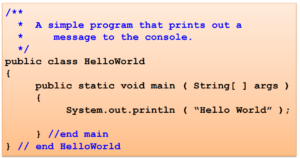
- The top of the program contains JavaDocs which are used to describe a program, class, method, or variable
- The comments at the bottom are in-line comments that are used to describe individual lines of code
- Everything inside the first set of curly braces is whats known as an Object.
- public class HelloWorld is known as the class header
- The class name should always be capitalized
- The code inside is known as the class body
- The inner set of curly braces is whats known as a method
- public static void main is the method header
- main is a method name and should be lowercase
- (String[] args) are the parameters of the method
- args is an identifier and should also be lowercase
- inside the method is known as the method body
- Each line of executable code known as a statement must end with a semi-colon